Flight Schools Near MIT
Local schools where club members train, ordered by driving distance from MIT. We don’t list prices, because we’re not endorsing one school over another. Contact each school directly for current rates and availability.
| School | Airport | From MIT | Fleet | Cockpit | What stands out |
|---|---|---|---|---|---|
| East Coast Aero Club New England's largest |
Hanscom (KBED), Bedford also Nashua NH (KASH), Norwood (KOWD) |
~15 mi 25-30 min |
Cessna 172 & 182 (G1000), Piper Warrior / Archer / Arrow / Seminole, Cirrus SR20 & SR22, Super Decathlon, helicopters | Both, steam and G1000 | Only local school with helicopters and aerobatic type; three airports |
| Horizon Aviation Cessna Pilot Center |
Norwood Memorial (KOWD) also Warwick RI (KPVD) |
~20-24 mi 30-40 min |
13 Cessnas: 152, 172 (R / S / SP), 172S G1000 | Both, steam and G1000 | Part 141 and the only one with a dedicated international students page |
| Mitiguy Aviation The only one training Sport Pilot |
Minute Man Air Field (6B6), Stow | ~25-27 mi 40-50 min |
Cessna 172 (x3), Piper Warrior, Piper Cherokee (x2) | Both, steam plus G5 and G1000 NXi | Trains Sport Pilot, and publishes its intro flight price |
| Beverly Flight Center Cirrus Training Center |
Beverly Regional (KBVY) | ~26-27 mi 35-45 min |
Piper Warrior / Archer / Arrow, Cessna 172M & 172N, Cirrus SR20 G6 (2022) & SR20 G7+ (2025) | Both, steam Pipers and glass Cirrus | Runs both Part 61 and 141, and has the newest Cirrus on this list |
| Avier Flight School Open since 2014 |
Beverly Regional (KBVY) | ~27 mi ~40 min |
Piper PA-28 family: Archer, Warrior, Cherokee; Cirrus SR22 | Both, steam Pipers and glass Cirrus | Self-paced Part 61, you and your instructor set the curriculum |
| FCA Flight Center At KFIT since 1999 |
Fitchburg Municipal (KFIT) | ~45 mi ~60 min |
Cessna 172 (x4), Cessna 152, Piper Arrow (PA28R), Cirrus SR20 & SR22 | Both, steam Cessnas and glass Cirrus | Six instrument instructors on staff, open seven days a week |





Glass or Steam Gauges?
Analog dials or digital screens. Most schools here fly both, so you can train on either.
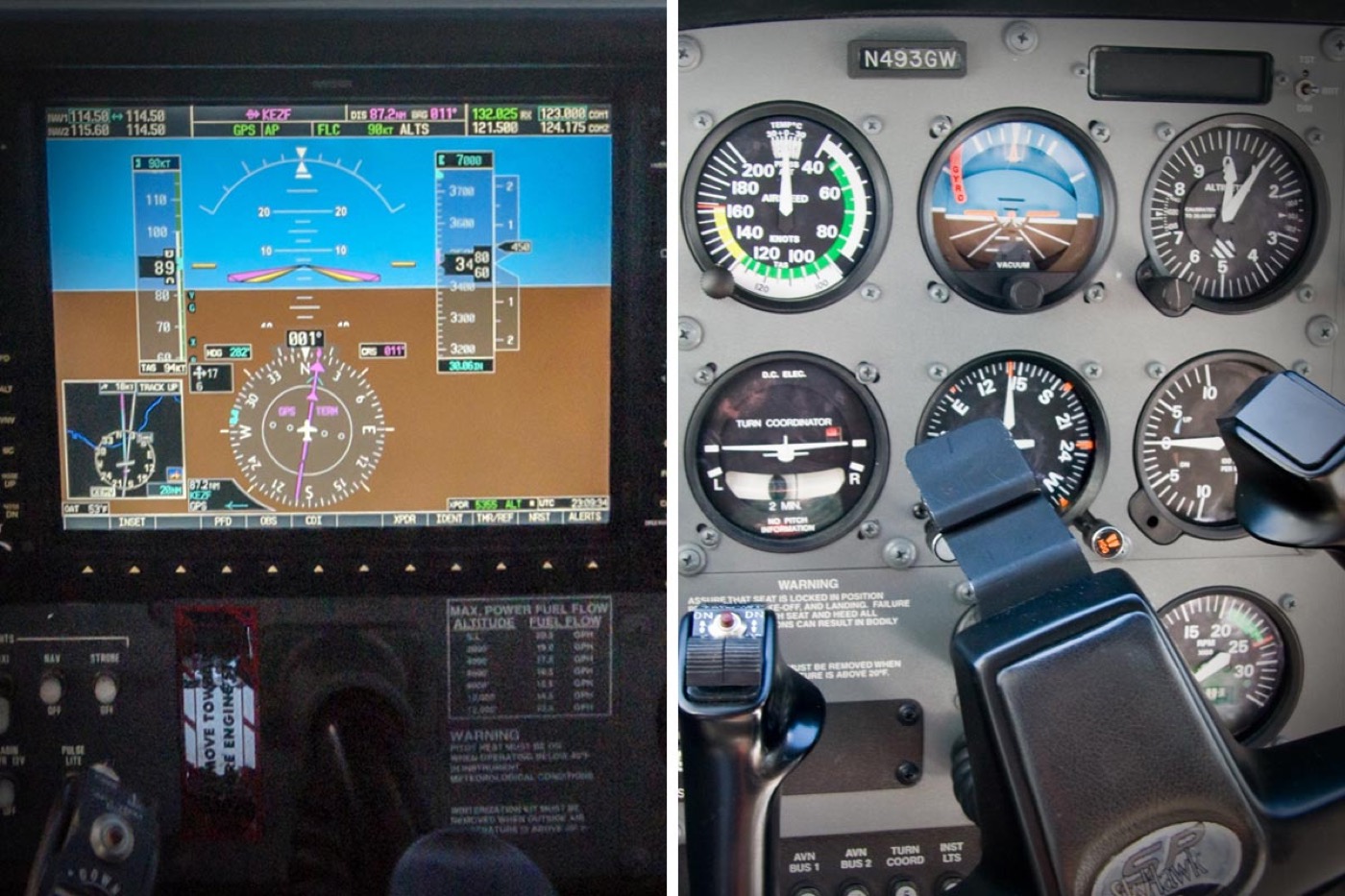
Glass cockpit left, steam gauges right.
Glass cockpit
Good for
- Map, terrain, traffic, and weather in one place
- No vacuum pump to fail
- Much lower workload in IFR
- Closer to what airlines fly
Trade-offs
- Costs more per hour
- Menus can pull your eyes inside
- Easy to lean on the automation
Steam gauges
Good for
- Cheaper hourly rates
- One failure does not take out the rest
- Builds a strong instrument scan
- Easy to find and book
Trade-offs
- No moving map, terrain, or traffic
- Vacuum failures are easy to miss
- Older airframes vary
Which should you learn on?
- Either. You can take your checkride in both.
- Switching later takes a few hours, not a new certificate.
- Common advice: build fundamentals on steam, add glass after.
- Heading for a commercial certificate? Ask how the school covers the 10 hours required in a complex or technically advanced aircraft.